
Med CPD – Learner Quality Score Guide
April 27, 2026
The Learner Quality Score, or LQS, helps Med CPD users understand the educational quality and practical value of CPD activities.
It is not a simple five-star rating.
The LQS is a structured learner feedback framework designed to assess whether a CPD activity was clear, relevant, engaging, useful, and likely to support meaningful professional development.
Rather than relying only on course descriptions, provider claims, promotional material, or general satisfaction ratings, the LQS focuses on the learning experience itself.
It helps answer a practical question:
Was this CPD activity worth the learner’s time, attention, and investment?
What Is the Learner Quality Score?
The Learner Quality Score is a proprietary questionnaire and scoring framework created for Med CPD.
It was developed to assess the qualitative components of professional education, including:
– clarity of learning outcomes
– relevance to the intended audience
– learner engagement
– professional context
– reflection
– supporting materials
– practical value
– potential impact on practice
The LQS is designed to provide a clearer signal of educational quality for healthcare professionals choosing between CPD options.
It does not replace formal accreditation, CPD Home requirements, regulatory standards, or professional judgement. Instead, it provides an additional learner-led quality signal based on the experience of people who completed the activity.
Why the LQS Was Created
Healthcare professionals often need to choose between many CPD options.
Some require payment. Some require travel. Some take time away from work, family, or clinical responsibilities.
The key question is often:
Is this CPD activity actually worth my time and money?
Course descriptions can explain the topic, speaker, venue, or format, but they do not always show whether the education itself was useful, engaging, relevant, or practically valuable.
The LQS was created to shift the focus back to educational quality.
It helps learners look beyond factors such as venue, food, social experience, or general enjoyment, and instead consider the actual learning value of an activity.
How the LQS Was Developed
The Learner Quality Score was created by Med CPD as a proprietary education quality framework.
It was developed using:
– qualitative research data
– educational data
– professional learning concepts
– learner feedback patterns
– adult learning principles
– continuing professional development concepts
– peer-informed wording review
The aim was to create a feedback tool that is simple enough for learners to complete, but structured enough to provide more useful insight than a basic star rating.
How the Learner Quality Score Works
After completing a learning activity, participants can evaluate their experience using several structured learning elements.
Each element is rated on a scale from 1 to 10.
These ratings are then combined to produce the overall Learner Quality Score for the activity.
The score reflects the collective experience of learners across multiple aspects of professional education.
A higher LQS suggests that previous learners found the activity clearer, more relevant, more engaging, more useful, or more likely to support meaningful professional development.
How LQS Feedback Is Collected
To protect the integrity of the Learner Quality Score, LQS feedback should be collected from confirmed attendees or participants who completed the learning activity.
For this reason, Med CPD does not send the LQS questionnaire broadly to the public or to unverified users who may not have attended.
In most cases, the education provider is best placed to send the LQS feedback form to confirmed participants after the activity has been completed.
This helps ensure that feedback reflects the experience of real learners and reduces the risk of responses from people who did not participate.
Where possible, Med CPD encourages providers to send the LQS feedback form shortly after the activity, while the experience is still recent.
Using the LQS QR Code
Med CPD now provides Education Providers with a downloadable QR code that links directly to the Learner Quality Score (LQS) questionnaire for their course or learning activity.
This gives providers an easy way to invite learners to provide feedback after completing an activity.
How to Download Your QR Code
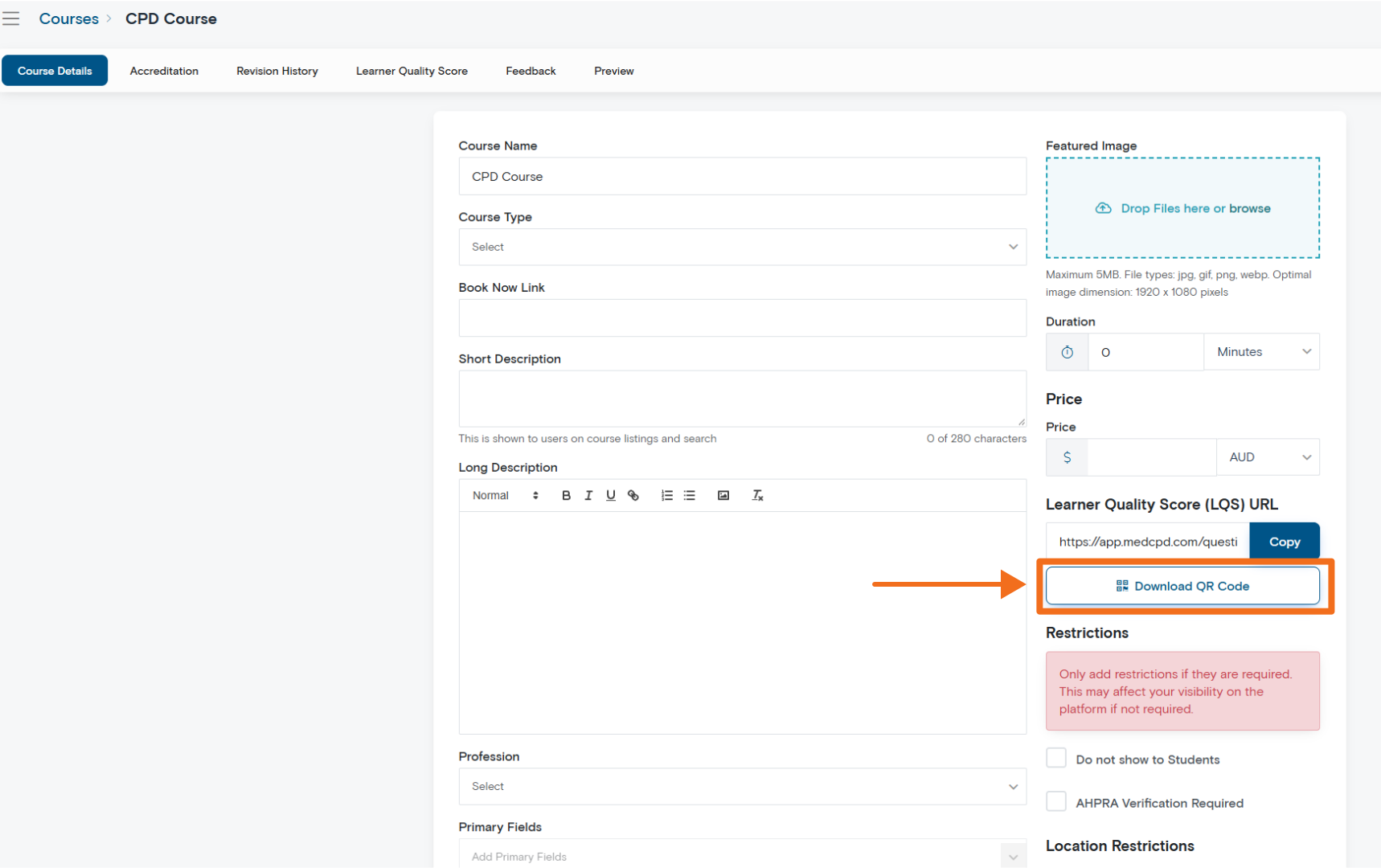
The QR code is available within your course listing in the Med CPD provider dashboard.
To access it:
-Open the relevant course.
-Go to the Course Details section.
-Find the Learner Quality Score (LQS) URL.
-Select Download QR Code.
-A QR code will be generated for your course.
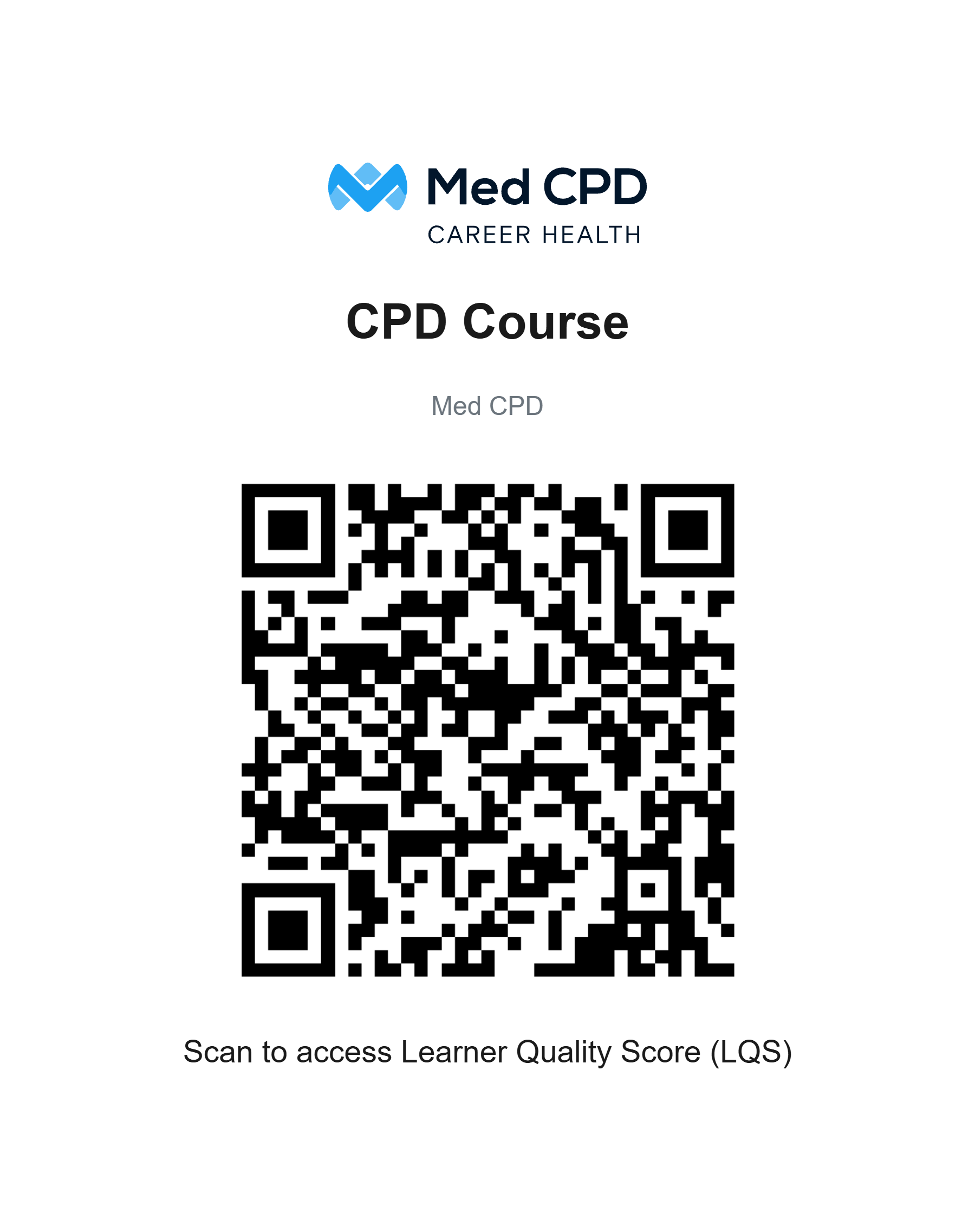
The downloaded QR code can then be shared with learners after they complete the activity.
How Learners Use the QR Code
Learners can simply scan the QR code using their phone or device.
The QR code takes them directly to the LQS questionnaire for that specific course, allowing them to provide feedback on their learning experience.
This can make it easier to collect feedback immediately after an education activity, while the experience is still fresh.
Where Can You Use the QR Code?
Providers can use the QR code wherever it is practical to invite feedback, including:
-Presentation slides
-Course materials
-Printed handouts
-Event signage
-Post-course resources
-Emails to participants
-Digital learning materials
The QR code provides another simple way to connect confirmed learners with the LQS feedback process.
Tip: Consider displaying the QR code at the end of a course or presentation so learners can scan it and provide their feedback before leaving the activity.
LQS Evaluation Elements
The Learner Quality Score is based on the following elements:
Clarity
How clear the learning outcomes were and whether the objectives of the activity were clearly communicated to learners.
Relevancy
How appropriate the learning outcomes are for the intended audience and whether they align with the scope of practice of the target profession.
Context
How well the content reflects the real-world environment and professional context in which the audience practices.
Outcome
How effectively the activity achieved its stated learning outcomes and supported the development of knowledge or skills.
Engagement
How engaging the learning experience was and how well it maintained attention and concentration throughout the activity.
Supporting Material
The usefulness and appropriateness of any supporting materials such as resources, references, slides, or additional learning tools.
Reflection
Whether the activity provided opportunities for learners to reflect on their own practice, behaviours, or knowledge.
Experience
A subjective rating of the overall learning experience.
Behavioural Change
The extent to which the learning encourages meaningful changes to professional practice.
Achievability
Whether the suggested improvements or changes to practice are realistic and achievable within the learner’s professional environment.
Why the LQS Matters
The Learner Quality Score helps healthcare professionals make more informed CPD decisions.
It helps learners identify activities that are:
– relevant to their professional needs
– clear in their learning outcomes
– engaging and well-structured
– practical for their work environment
– useful for knowledge or skill development
– more likely to support meaningful reflection or change
For Med CPD, the LQS also supports quality-driven discovery.
Activities with stronger learner feedback may be better positioned within the platform because they provide clearer evidence of value to learners.
This helps encourage a CPD environment where providers are recognised for the quality of the education they deliver, not only for their marketing reach, brand size, or promotional visibility.
How the LQS Helps Providers
The LQS also supports education providers by creating a clearer feedback loop.
Structured learner feedback can help providers understand:
– what learners found valuable
– whether the content matched the intended audience
– whether the activity achieved its learning outcomes
– where materials, delivery, or structure could be improved
– whether learners felt the education was practical and achievable
This supports continuous improvement and helps providers refine their education over time.
Why Learners Should Ask About the LQS
As the Learner Quality Score becomes more widely used, healthcare professionals can begin asking education providers:
Do you have a Learner Quality Score?
This helps shift the conversation toward education quality, transparency, and learner value.
It also encourages providers to collect structured feedback from participants and demonstrate how their activities are experienced by real learners.
Want to Provide Feedback?
If you have completed a CPD activity listed on Med CPD, you may be able to provide feedback through the education provider’s LQS feedback process.
Because the LQS is designed to reflect the views of confirmed participants, feedback forms are generally distributed by the provider after the activity has taken place.
If you have thoughts about the Learner Quality Score, CPD quality, or how Med CPD can continue improving, you are welcome to create a free Med CPD account and join our community.
Through the Med CPD Community, you can share feedback, take part in discussions, and help shape how the platform continues to develop.
Summary
The Learner Quality Score is a structured, learner-led quality framework that helps healthcare professionals better understand the value of CPD activities.
It was created to move beyond simple satisfaction ratings and provide clearer insight into educational quality, relevance, engagement, reflection, and practical impact.
For learners, the LQS supports better CPD decisions.
For providers, it supports meaningful feedback and continuous improvement.
For Med CPD, it helps make high-quality education easier to discover.
Share to: